
Wake Boats
A COMPROMISE BETWEEN HAVING FUN AND PROTECTING OUR LAKE HABITAT
Here’s how WAKE BOATS work
Wake boats are specifically designed to greatly increase wave height and depth. They can produce waves with up to 17 times the energy of other comparable-sized power boats. The ballast tanks sink the boat deep into the water, and the powerful engine “plows”the vertical-oriented boat deep into the water with their propellers pointed down to the bottom of the lake. The wake surfer then lets go of the start rope and surfs on the enhanced wave. “Surf City, USA” This “giant wave action” looks like fun but creates massive environmental effects that are detrimental to the health of our fresh water lakes.
HERE ARE THE CONCERNS
Wake boats create large wakes and increase bottom scour that is a threat to natural resources in inland lakes. Their propellers can resuspend bottom sediments in water up to 33 feet deep. In addition, the use of large ballast tanks results in the dramatic increase of transporting microscopic aquatic invasive species and pathogens from one lake to another. The cumulative negative effects of wake boats on natural ecosystems can lead to loss of habitat, resulting in the decline of lake ecosystems and greatly affect angling opportunites and other recreatonal uses of a lake.
SHORELINE EROSION, SEDIMENTATION AND FISH POPULATIONS
- Shoreline erosion can lead to degradation of fish habitat and reduce water quality due to physical disrupton of rooted plants and resuspension of sediments and nutrients.
- Sedimentation decreases water clarity, reduces the ability of fish to find food and aquatic plants to grow and increases turbidity and phosphorous concentrations
- Aquatic Invasive Species (AIS) will be spread by chopping wave action with increased fragmentation
- Filling and emptying ballast tanks from lake to lake will quickly spread microorganisms
- Transportation of fish pathogens is also possible
See LATEST NEWS in our NEWS dropdown menu for more information
HAVING FUN WHILE PRESERVING OUR ECOSYSTEM
What can be done to minimize the effects of wake boats?
The amount of damage reported from wake boat use varies from place to place because of variables such as:
- size of lake
- depth of lake
- lake topography and structure
- local ordinances restricting use
- wave height restrictions
- distance from shore regulations.
Water regulations are controlled by your local government. Many local town boards are creating ordinances in an attempt to mitigate the effect of wake boats without restricting their use completely. An example “Wakes exceeding 2 feet prohibited unless more than 700 feet from shore”. This common standard is emerging and has become law in nearby states and towns.
Wake Boats represent a clear and present danger unless precautions are taken. This story is evolving almost daily. Look to our News Page for latest updates.
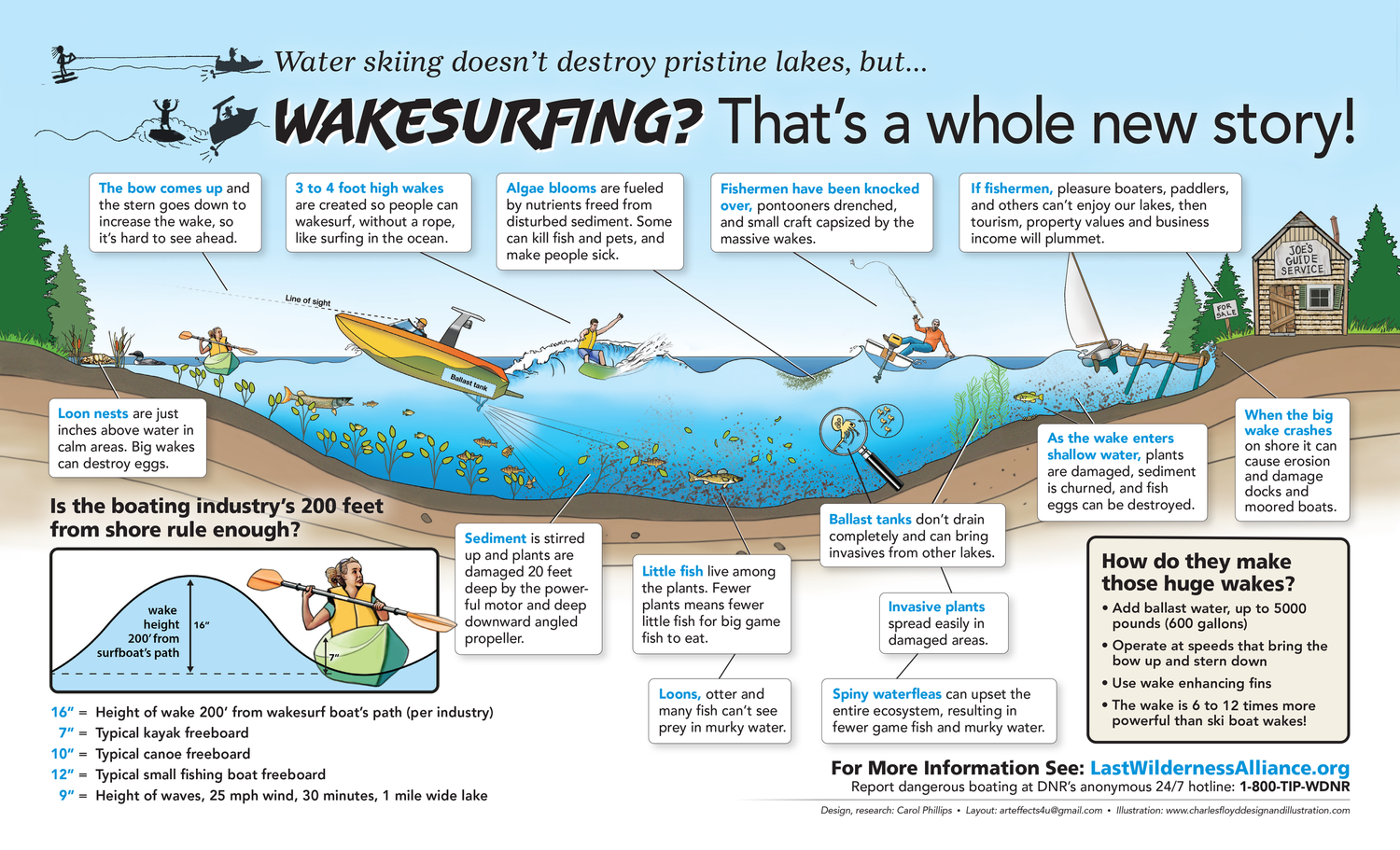
How is wakesurfIng difFerent from water skiing?
- Water ski boats are designed and operated to make the smallest wake possible, to provide a smooth ski.
- Surf boats are designed and operated to make the largest wake possible, so someone can surf, like in the ocean.
- Skiers use a long rope and go ~25 mph. Surfers use rope only to start, then surf ~15 f behind the boat at ~11 mph.
How big are the wakes?
They can be 3 to 4 feet high or more where the surfer is. [1] As the wake moves toward shore it breaks, losing some of its height and energy. But because it started out so big, even after traveling 200’ toward shore the wake is still 16” high, vs 7” for the same boat going faster in cruise mode, based on the study paid for by the boating industry. [2] That study also shows that only the most exposed shores of the largest lakes experience wind waves as big as 16”waves from surfing 200’ away. A shore that overlooks 2 miles of open water (2-mile “fetch”) would have 16” waves only if the wind was at least 30 mph for 45 minutes, which is extremely rare, and a very large lake. [3] Most lakes never see such big wind waves, but surf wakes impact even the most sheltered shores. The underwater energy in the surf wake moving toward shore also extends deeper, so it’s not only the shoreline being damaged; lakebed sediment and vegetation are churned and damaged. Fish and wildlife that nest in sheltered areas are suddenly exposed to powerful wave energy. Loon eggs can be toppled or chilled [11] and fish eggs are tossed or smothered with silt.
What about the safety of other boaters?
Other boaters are blindsided by huge waves, still over a foot high from a surfboat that never came within a football field of them (300’). [2] Fishermen are especially vulnerable; they often stand to cast, facing shore, anchored, unaware that a huge wake is about to broadside their boat. Even people in large boats who see the wake coming in time to turn into it have been tossed, injured, and soaked, and their boats damaged. Waves lose very little energy as they travel over deep water. Surfers are often unaware that their wakes are still dangerous for others several hundred feet away; by the time the wake hits them the surf boat is too far away to see it happen. Yet the industry’s “Wake Responsibly” campaign says no more than “Steer clear of parked boats and smaller watercraft”. [4]
How do they make that huge wake?
- While surfing, the boat maintains “transition speed”, that inefficient bow-high plowing speed not quite “on plane”, about 10-12 mph. This makes a much bigger wake than going slower or faster, like a planing cruiser or ski boat.
- Surfboats have ballast tanks that fill with about 2000 to 5000 pounds or more of lake water to force the boat deeper into the water to further increase the wake. That’s like putting a car on top of the boat.
- Wedges and fins can be deployed to further increase and shape the wake.
Why does the propeller wash extend so deep?
The propeller is angled about 30 degrees below horizontal (bow-high) boat angle plus prop shaft angle). A powerful 350-600 hp motor is used. Bow and stern waves also extend very deep as the heavy boat pushes water aside, then water rebounds to fill the void behind the boat. The impact is 20-25’ deep or more, far deeper than for other activities on inland lakes. [5] Sediment and pollutants like phosphorus and mercury that remained harmlessly entombed in deep sediment for decades can be reintroduced into the water and food web. [10] Watch the lakebed explode 14’ deep on this U of MN video: https://www.youtube.com/watch?v=Y-VZvVGk5Q0
Does the bow-high position impair forward visibility?
Check out photos and videos, even on manufacturers’ websites.
How do ballast systems spread invasive species?
Ballast systems don’t drain completely, and several gallons of lake water can remain in the tanks, piping, pumps, etc. When ballast is filled and emptied in a different lake, that residual water and any invasives (zebra mussel larvae, spiny waterflea, bits of invasive plants, etc.) are transferred. Some invasives can survive many days because closed ballast systems don’t dry out. [6] Tanks are often inaccessible, under the boat’s deck, so they cannot be inspected and are difficult and expensive to decontaminate, requiring lots of hot water and a trained operator. See a typical ballast system at [7]. Some owners’ manuals say not to try to empty the tanks completely because pumps will be damaged. [9] Failure to empty all water when leaving a lake violates Wisconsin law (NR 19.055 and NR 40). Many manuals say to add several gallons of antifreeze in winter to prevent that residual water
from freezing and causing damage. Then they say to drain that antifreeze into the lake in spring, [8]. That is also illegal.
REFERENCES
[1] Per this video sponsored by Malibu, the wakes, where surfing, are 2’-5” to 4’-5” https://www.guinnpartners.com/boat-testing/
[2] 2015 study by Goudey, for Water Sports Industry Association, page iv and 24. Data is for their deeper lake. (For shallow lake data
the boat was in water only 8’-10’ deep (p 2, 4). https://www.wsia.net/wp-content/uploads/2020/03/WSIA_draft_report_Rev_II.pdf
[3] Fig 28 of [2] (2 typos: “1.2 s” is “1.25 ft” and “50 ft” is “1.50 ft” per rev. VDOT). Madison airport reports wind speeds hourly, more
in storms. Only 4 measurements over 25 mph in all of 2023, only 1 over 30 mph, wunderground/history (gusts are less than 20 sec).
[4] See videos and posters at WSIA.net and WakeResponsibly.com
[5] See p 82-83 at https://conservancy.umn.edu/items/6a47c506-6be5-4c8a-9a96-dfea38f23b2f
p 10 at https://nlmddotorg.files.wordpress.com/2022/07/nlmd-phase-2-study-report-july-20-2022-with-appendices.pdf,
p 21 at https://www.warrenct.gov/sites/g/files/vyhlif3991/f/uploads/lake_waramaug_final_report.pdf
and p 5 at https://www.documentcloud.org/documents/26183324-lake-beulah-wave-impact-study-phase-3-report-092925/
[6] See p 5 at https://lmcd.org/wp-content/uploads/2022/06/Residual-water-in-ballast-bags-study-WI.pdf
[7] See p 4-7 at https://nautique.blob.core.windows.net/boat-manuals/2023/2023-G-Series-Manual.pdf
[8] Manuals such as p 374-376 at https://www.mastercraft.com/media/aizbwk5r/mastercraft_my2022_ownersmanual.pdf
[9] page 121 at https://cdn.malibuboats.com/docs/ownermanuals/2024%20Malibu%20Owner%27s%20Manual.pdf?_ga=2.136996405.482784965.1713270232-1686420796.1713270232
[10] P 5 https://mymlsa.org/wp-content/uploads/2023/07/Fisheries-Report-37-Wake-Boat-Study-Official-Version-Released-on-7.28.2023.pdf
[11] https://maineaudubon.org/projects/loons/your-loon-questions-answered/ 9/26/2026